
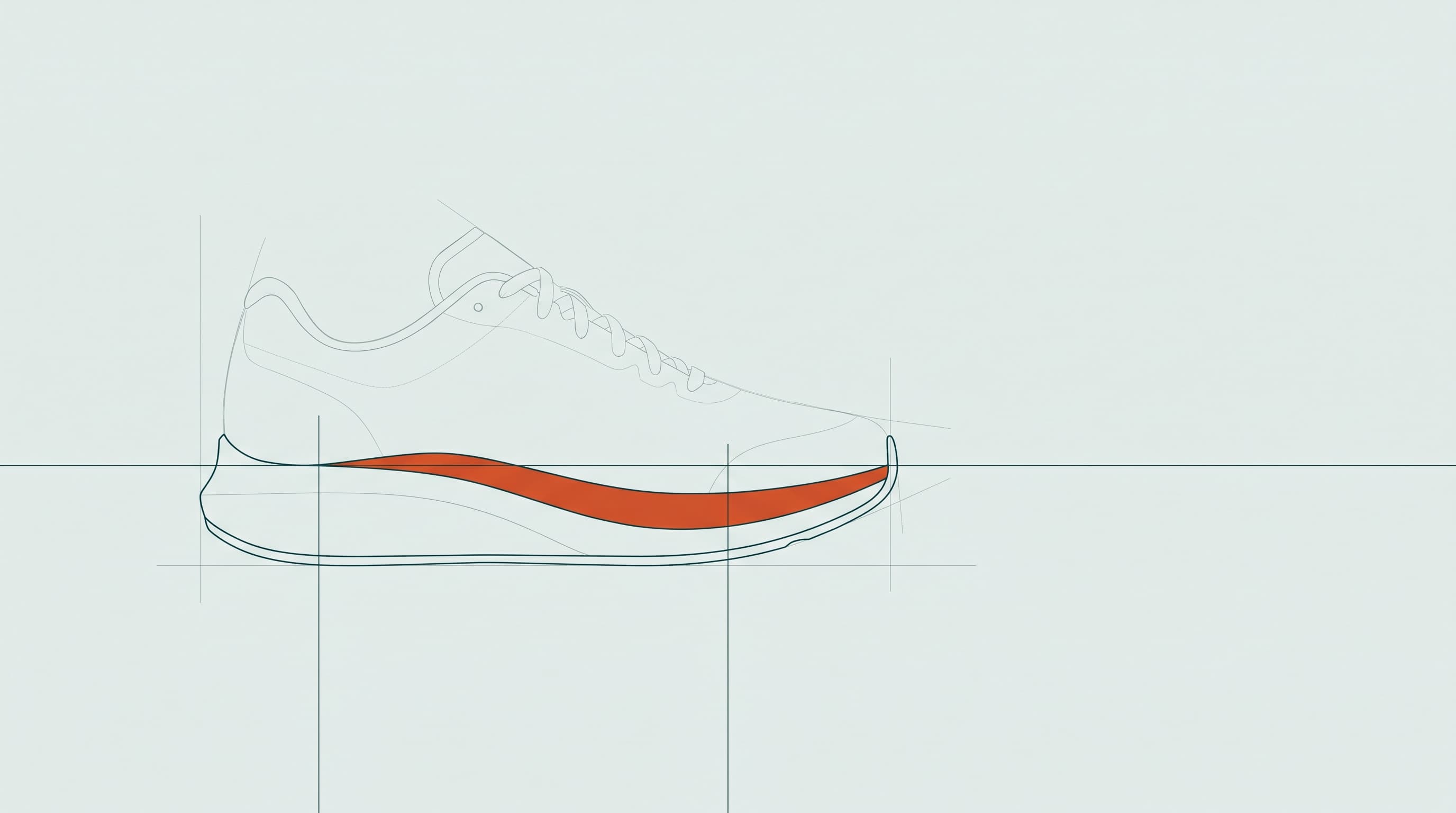
The Nike Alphafly 3 has a 38.1-millimeter heel and sits on World Athletics' approved list. The Asics Superblast has a 42.7-millimeter heel and does not.
World Athletics, the sport's global governing body, sets a 40-millimeter limit on a road shoe's sole, and no more than one rigid plate inside it. That is the rule behind nearly every headline about carbon-plated shoes. It binds a defined category called World Rankings Competitions, and a marathon enters that category only by sanction.
Where the 40-millimeter limit came from
At the Rio Olympic marathon in August 2016, Kipchoge, Lelisa and Rupp took all three medals wearing Nike Vaporfly prototypes made to resemble Nike's standard marathon shoe. Nike unveiled the finished version in March 2017 as the Zoom Vaporfly Elite, and on 6 May 2017 Kipchoge ran 2:00:25 in it at Breaking2, an exhibition marathon staged at Monza that was never eligible for record ratification.
In April 2018, researchers Hoogkamer and Kram published a study in Sports Medicine measuring the Vaporfly's effect on running economy. The paper found a four percent improvement, and that number became the shoe's nickname. On 12 October 2019, Kipchoge ran 1:59:40.2 at the INEOS 1:59 Challenge in Vienna, a run built on rotating pacemakers and bicycle-delivered hydration that was also never eligible for ratification.
World Athletics announced new shoe rules on 31 January 2020, days before the U.S. Olympic Marathon Trials. A road shoe would be capped at 40 millimeters, a spiked shoe at 30, and no shoe could contain more than one rigid plate. A new shoe would also have to sit on open retail sale for four months before an athlete could race in it.
What the rule says today
The 40-millimeter road limit has not moved since 2020. On 1 January 2022, the sole-thickness rule moved out of the old Technical Rule 5.13 and into a standalone regulation, Book C, C2.1A. The track limit tightened to a flat 20 millimeters on 1 November 2024, and cross-country races became exempt from any sole-thickness limit on 1 April 2026, joining mountain and trail races. The road limit itself is measured at two fixed points on a shoe placed flat, the center of the heel and the center of the forefoot.
Measuring shoes to the protocol World Athletics uses, RunRepeat found the Puma Fast-R Nitro Elite 3 reads 38.5 millimeters at the heel and passes legally, even after noting that moving the calipers toward the midfoot found the shoe clearly over 40 millimeters there. The cap applies only at those two fixed points, with a 2-millimeter tolerance built into the check, and nothing stops a shoe from bulging past 40 millimeters everywhere else.
The Nike Vaporfly 4 measures 34.1 millimeters at the heel, the Adidas Adizero Adios Pro 4 measures 36.6, the Nike Alphafly 3 and the Saucony Endorphin Pro 4 both measure 38.1, and the Hoka Cielo X1 comes in at 39.8, all of it lab-measured to one consistent protocol. Every one of those is a shoe built to race in. The shoes clearly over the line sit in a separate cluster starting at 42.7 millimeters, the Asics Superblast, and running up through 45.6 for the Saucony Kinvara Pro and 46.3 for the Hoka Skyward X. Those are cushioned daily trainers. Manufacturers appear to design right up against the limit or ignore it completely, with almost no shoe measured in between.
Two claims about the list that no longer hold
World Athletics keeps a public list of every shoe cleared to race, published at certcheck.worldathletics.org. On 31 August 2026 it held 970 approved model entries from 64 manufacturers. 883 of them are ordinary Available Shoes. The other 87 are Development Shoes, a prototype category built for sponsored athletes and capped at twelve months of use. Mizuno led the list with 158 entries, ahead of Asics at 140, Nike at 74, Puma at 73 and Adidas at 67.
Nearly every other page states that a shoe must sit on open retail sale for four months before an athlete can race in it. That was true once. It is not true of the current regulation. Appendix 3 of the 2026 rule requires only that a shoe be available for purchase, including through a pre-order, before the athlete's first competition in it, and a manufacturer has no obligation to restock it once it sells out.
The Asics Novablast 4 measures under 40 millimeters at the heel in RunRepeat's lab, and it still does not appear on the approved list. Ironman's ban list names it anyway, alongside the Novablast 5, the Adidas Adizero Prime X family, the Asics Superblast line and the Saucony Kinvara Pro. World Athletics' own list preamble explains the gap. A shoe can be missing because a manufacturer never submitted it, not because it broke a rule. Submitting a shoe costs a fee per model, so a brand generally only pays for the shoes it expects an elite athlete to race in.
The original New Balance FuelCell SuperComp Trainer used roughly 47 millimeters of foam, illegal under any reading of the rule. New Balance rebuilt it, and both the second and third versions are now on the approved list. Ironman's ban list still names the SuperComp Trainer without a version number. Checking the exact model and version against the live list settles the question either way.
Which races the rule reaches
Regulation 3.1 states that World Athletics' rules apply to World Rankings Competitions, to the athletes competing in them, and to World Athletics officials. Nothing else. A World Rankings Competition covers three tiers, events held or sanctioned by World Athletics itself, by an Area Association, or by a national federation. The national-federation tier is the one that matters for a local race, and it is opt-in. It covers national championships and any domestic race the federation has specifically identified, applied for, and had approved. A local marathon does not fall inside the rule by default.
World Athletics' own FAQ states directly that the regulations are not intended to cover club, school, college or masters-level competitions, because that level of competition is not relevant to international rankings and can run under its own rules. Combined with the sanctioning requirement, that carve-out leaves an unsanctioned race outside the rule entirely.
Shoe Control, the process that verifies footwear, is barred from the call room and can only run after an athlete has finished competing. World Athletics' FAQ describes the officer's job as noting who the athlete is, photographing the shoe, and recording whether it matches the approved list. No sole gets measured. A shoe is only collected for lab testing if a world record was set or an official already suspects a problem, and declaring a shoe before the race is voluntary. Even inside a competition the rule reaches, nothing in that process was built to screen a field of thirty thousand people.
Boston binds only the Professional Start
The Professional Start is the small paid elite field that starts ahead of everyone else. In the 2027 B.A.A. Boston Marathon Rules and Policies, dated 20 August 2026, Rule 6.2.2.1 requires shoes worn in the Professional Start to comply with World Athletics' regulations and to sit on the approved list. If a World Best is set, or an official suspects a problem, the shoes go to a lab for testing. Boston's 2021 rulebook carried the identical wording in the identical place, so this is not a recent tightening.
A valid Boston qualifying time depends on eight criteria, among them a certified course, an exact 42.195-kilometer distance, at least three official starters, public promotion and timed splits. A sixth, new for 2027, adjusts for courses with significant net downhill. None of the eight mention footwear. The B.A.A. verifies a submitted time against the results an event organizer or timing company provides, and calls those results final. A runner qualifying for Boston in a training shoe is governed by that set of criteria. A professional racing down Boylston Street in the same shoe is governed by Rule 6.2.2.1.
A runner checking whether a finish time clears the current standard can run it through 42cal's Boston qualifier calculator, which asks for age, gender and finish time and nothing about the shoe on the runner's feet.
Ironman and World Triathlon check the whole field
In section 6.02(e), Ironman's 2026 Competition Rules prohibit shoes over 40 millimeters or built with more than one rigid structure, with disqualification as the penalty. The rule sits in the general section governing every Ironman and Ironman 70.3 race, not one reserved for professionals, and athletes are subject to random shoe control before, during or after any race. An unidentified shoe gets sent to World Triathlon for verification within seven days, and a confirmed violation ends in disqualification.
World Triathlon's 2026 rulebook, dated 13 December 2025, runs shoe control from the moment the Athletes Lounge registration opens until 20 minutes after the last finisher crosses the line, for elite, youth, junior, under-23 and para competitions. For age-group competitions, the same rulebook holds that window open until 45 minutes after the last finisher, and any athlete in the field can be checked.
What the four percent number means
Where the data disagrees. The four percent gain attached to carbon-plated shoes comes from one 2018 lab study, funded by Nike, that compared eighteen high-caliber runners against 2017-era racing flats with the shoe weights matched. Independent research since puts the pooled benefit closer to two to three percent, and the best real-world estimate, drawn from actual marathon results rather than a treadmill, lands lower still.
Every one of the eighteen subjects in the 2018 study ran more economically in the Vaporfly than in the comparison flats. Two of its authors were Nike employees at the time, and Kram worked as a paid Nike consultant.
A 2019 study by Barnes and Kilding found a 2.9 percent gain over an Adidas Adios racing shoe once the Vaporfly was weighted to match the Adios, the cleanest isolation of the plate and foam alone. A 2026 meta-analysis by Kobayashi and colleagues, pooling fourteen crossover trials with no declared industry funding, put the average metabolic saving at 2.75 percent against non-plated shoes. An observational study by Guinness and colleagues, tracking real marathon results for the same athletes before and after they switched into Vaporflys, is the only one of these measured on an actual race day rather than a treadmill. It found finish times improved 1.4 to 2.8 percent for men and 0.6 to 2.2 percent for women, and the authors describe that as an expected improvement rather than a guaranteed one.
Running economy, the amount of oxygen a body burns to hold a pace, is not the same measurement as a finish time, and the study populations behind these numbers were trained or elite athletes rather than a recreational field. Four percent is not a number a five-hour marathoner should expect to see on a finish clock.
What it comes down to
The shoe performs the same regardless of who races in it. What differs is who has the authority to check it. A runner entering a local marathon with no federation sanction sits outside World Athletics' scope entirely. A runner submitting a Boston qualifying time is bound by eight criteria that never mention a shoe. A runner in a World Athletics label race is inside the rule, but the check that follows is a post-race photograph of a small number of elite finishers. A runner in an Ironman or a World Triathlon age-group event is the one case where the shoe is subject to random control, with disqualification as the stated consequence.
Whether a race checks matters more than whether a shoe is legal. For most runners browsing 42cal's race directory for their next marathon, that is what settles it.