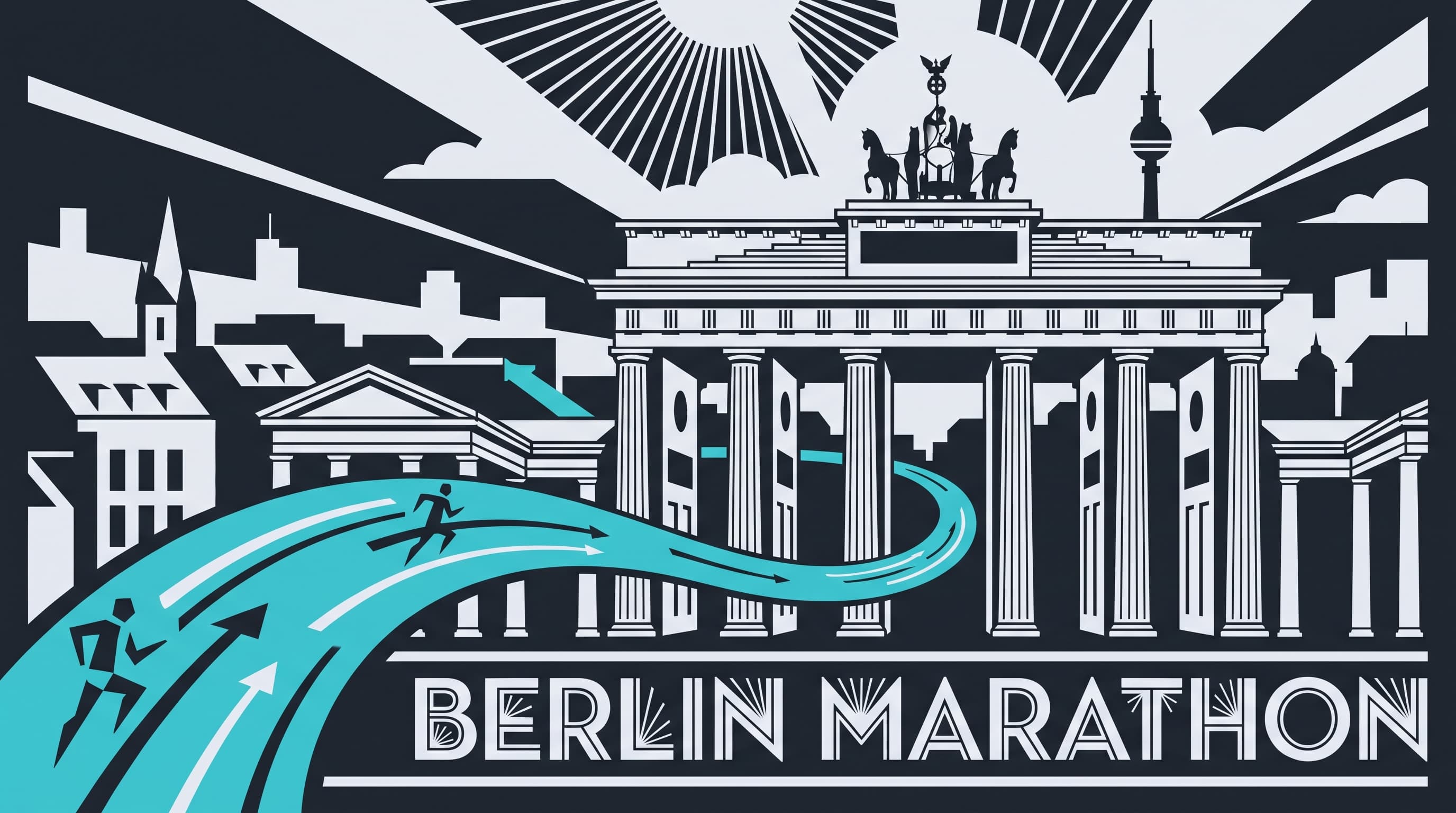
No course in modern marathon history has produced more world records than Berlin's. Between 1998 and 2022, men racing the BMW Berlin Marathon, one of the Abbott World Marathon Majors that make up the sport's biggest annual race series, lowered the marathon world record nine separate times, and women broke theirs there four more. That is not a coincidence of talent showing up on the same Sunday every year. It is a course built almost dead flat, run on a morning that is reliably cool and calm enough to hold a pace precisely. For a first-timer standing at the start line near Tiergarten, Berlin's big central park, that history matters less as trivia and more as permission: this is a legitimate day to chase your own personal best rather than simply survive 42.2 kilometers.
Why Berlin Is a Personal-Best Course
The elevation numbers back up the reputation. Berlin's course climbs a total of about 73 meters over the full distance, compared with roughly 247 meters on Boston and New York, two courses that spend real miles working uphill. Tokyo edges Berlin slightly on paper, but no other Major combines that near-zero net elevation with Berlin's long, straight boulevards and near-total absence of tight turns. It's that combination, not the raw gain number alone, that earns Berlin its reputation as the flattest, fastest course profile among the Majors. It is also a recognized Boston Marathon qualifying course, which is part of why so many first-timers come here to chase a Boston qualifier.
Weather does the rest. Race day falls in late September, when Berlin mornings typically sit around 10 to 11°C (50 to 52°F) at the 09:15 start, humidity stays low, and the odds of rain by that point in the month are under one in five. Cool enough that runners aren't fighting heat, mild enough that nobody needs more than a throwaway layer at the start line. That combination is the physiological argument for why Berlin, more than any other Major, keeps producing fast times at the front of the field and steady, even pacing further back in it.
Steady pacing is the part first-timers underrate. A flat, fast course invites a specific mistake: banking time in the first ten kilometers because the legs feel that good and the road never pushes back. Berlin punishes that decision the same way any marathon does, just later and more quietly, because there's no hill to blame when the pace falls apart. The course gives you the conditions for an even effort. It doesn't give you the discipline to run one, so it pays to turn a recent race result into a realistic target with a race time predictor before you toe the line.
The record book bears out the reputation. Eliud Kipchoge ran 2:01:09 in Berlin in 2022, the fastest marathon run to that point, and Dennis Kimetto had done the same thing eight years earlier with 2:02:57. Both times were the world record on the day they were set in Berlin. The men's world record has since moved on, Kelvin Kiptum ran 2:00:35 in Chicago the following year, but the pattern holds: when someone is ready to run the fastest marathon of their life, Berlin is disproportionately where it happens.
The Course, Landmark by Landmark
None of that means the race is easy, and the course has one stretch that proves it. The route starts on Straße des 17. Juni and heads out past the Reichstag, Germany's parliament building, and the Victory Column, a gilded monument marking the roundabout at the center of Tiergarten, before threading through roughly ten Berlin districts, Charlottenburg, Moabit, Mitte, Friedrichshain, Kreuzberg, and Neukölln among them. Potsdamer Platz, a glass-and-steel plaza rebuilt after reunification, arrives around kilometer 30, a spot local runners treat as a checkpoint: if you still feel good here, you've earned the right to push.
What comes next is the test. From Potsdamer Platz the course turns onto Kurfürstendamm, the grand shopping boulevard locals call the Ku'damm, for a long, straight run from about kilometer 30 to kilometer 38.
What the data actually says. Flat is not the same as easy. Runners and coaches who've raced Berlin repeatedly single out that Ku'damm stretch, eight kilometers of straight road with nothing to break the rhythm, arriving right when the marathon wall usually shows up, as where the race is actually won or lost. A pancake-flat course removes one kind of difficulty, the hills, and replaces it with another: nothing to distract you from how much your legs hurt.
From Ku'damm the course narrows back toward the center. With around 600 meters to go, runners cross a double line of cobblestones set into the road, marking the exact line where the Berlin Wall once stood, and then pass directly through the Brandenburg Gate itself before finishing back on Straße des 17. Juni, the same street the race started on. It's a short, deliberate closing sequence on a course that is otherwise smooth asphalt from start to finish, and it's built to be the emotional high point after the hardest miles.
Support along the way is dense. Aid stations arrive roughly every five kilometers, alternating between water-only stops, at kilometers 5, 12, 17.5, 22.5, 27.5, 32.5, 34.5, 38, and 40, and fuller stations offering sports drink and fruit or tea at kilometers 9, 15, 20, 25, 30, and 36. Maurten, the official on-course fuel, is handed out as drink mix at those six fuller stations and as a gel around kilometer 27.5; runners carrying their own hydration systems can refill at every stop. Medical support scales up in the closing miles, with teams stationed at every water point and roughly every kilometer from 36 km onward, and the course carries an overall time limit of 6 hours 15 minutes, enforced at checkpoints around kilometers 33 and 38.
Race Morning: Start Groups and Pacing
Race morning itself starts at 09:15 on Straße des 17. Juni, Brandenburg Gate behind you, Victory Column ahead. You won't all go off at once. Berlin sorts runners into lettered start groups, A through K, based on best or predicted finishing time, then releases those groups in staggered waves across the morning, so a five-hour first-timer isn't shuffling around someone chasing 2:15 in the first mile. You can request a group change through your runner account, but only up to a deadline in late August, roughly a month before race day, and if you're claiming a fast time to move up (under about 3:15) you'll need proof of it. Official pacers carrying flags for target times between 3:00 and 5:00 run through the field for anyone chasing a specific number, spaced out across the groups they belong in.
Race Week: Expo, Transit, and the Weekend Before
The unglamorous logistics matter almost as much as the course. Every runner has to collect their own bib in person at the Messe Berlin expo, on the two days before the race; there is no race-day pickup, and no one else can collect it on your behalf, not a friend, not a partner, not a fellow runner holding your documents. Pickup requires two things: the Start Card, emailed roughly ten days before the race, and a photo ID, a passport or driver's license. Bring both or you're turned away.
Once you have that bib, it does double duty as a four-day public transit pass across Berlin's BVG network, the city's combined subway, tram, and bus system, valid across the ABC fare zone from the Thursday before the race through race-day Sunday. It's a real cost saver for a runner already paying for flights and a hotel, and the details ship with the Start Card email. The Saturday before the marathon is its own small festival on the same streets: a 5K run over the marathon's final five kilometers, plus an inline-skating event, both sharing the course before the runners take it over on Sunday.
How to Actually Get In: Entry Routes for 2027
Getting to that start line is its own project, and if you're reading this now, 2026 general entry has already closed; the lottery opened in late September 2025 and shut on November 6. The realistic plan for a first-timer is 2027, and Berlin's lottery runs on a predictable annual pattern: registration opens in late September, closes in early November, and results land by email at the end of that month. If you want a sense of how long those odds really are, we broke down the ballot odds across every Major separately. Entering the lottery itself costs €205, and no qualifying time is required to apply.
Runners who do have a fast recent marathon result can register as a fast runner, which folds you into that same lottery pool rather than granting an outright guarantee, but meaningfully improves your odds. The qualifying times are split by age and sex: for men, that's sub-2:45:00 for ages 18 to 44, sub-2:55:00 for 45 to 59, and sub-3:25:00 for 60 and over; for women, sub-3:10:00 for 18 to 44, sub-3:30:00 for 45 to 59, and sub-4:20:00 for 60 and over. The time has to come from an official result, an AIMS-certified or Abbott-listed race, submitted with a link to the results page; a Strava file or a screenshot won't be accepted.
Charity entry sidesteps the lottery outright. Official partners, including the aggregator Realbuzz, connect runners to more than a hundred charitable organizations, and completing a fundraising commitment for one of them secures a guaranteed bib. The minimums vary by charity and country, typically somewhere in the range of £850 to £1,500 in the UK or $3,000 to $5,000 and up in the US, on top of the €250 race-entry fee itself. Tour operators offer a third guaranteed route: official travel partners, active in more than fifty countries, bundle a confirmed bib with a hotel, and sometimes flights or airport transfers, for runners who would rather pay a premium than gamble on the lottery. There are also a handful of smaller, loyalty-based doors, a guaranteed spot for runners who've finished Berlin ten or more times through the Jubilee Club, and a limited allotment of reduced-price Sozialticket entries for eligible Berlin residents, worth knowing exist even if they won't apply to most first-timers. Full logistics and the current schedule are on the race page on 42cal.
Roughly 45,000 to 55,000 runners finish Berlin each year; the 2024 edition, at around 54,000 finishers, was briefly the largest marathon ever staged. The flat course and the cool morning make Berlin fast. The record book, nine world records deep, makes it legendary. For a first-timer standing at that start line, that adds up to a legitimate shot at finding out what your legs can actually do.