
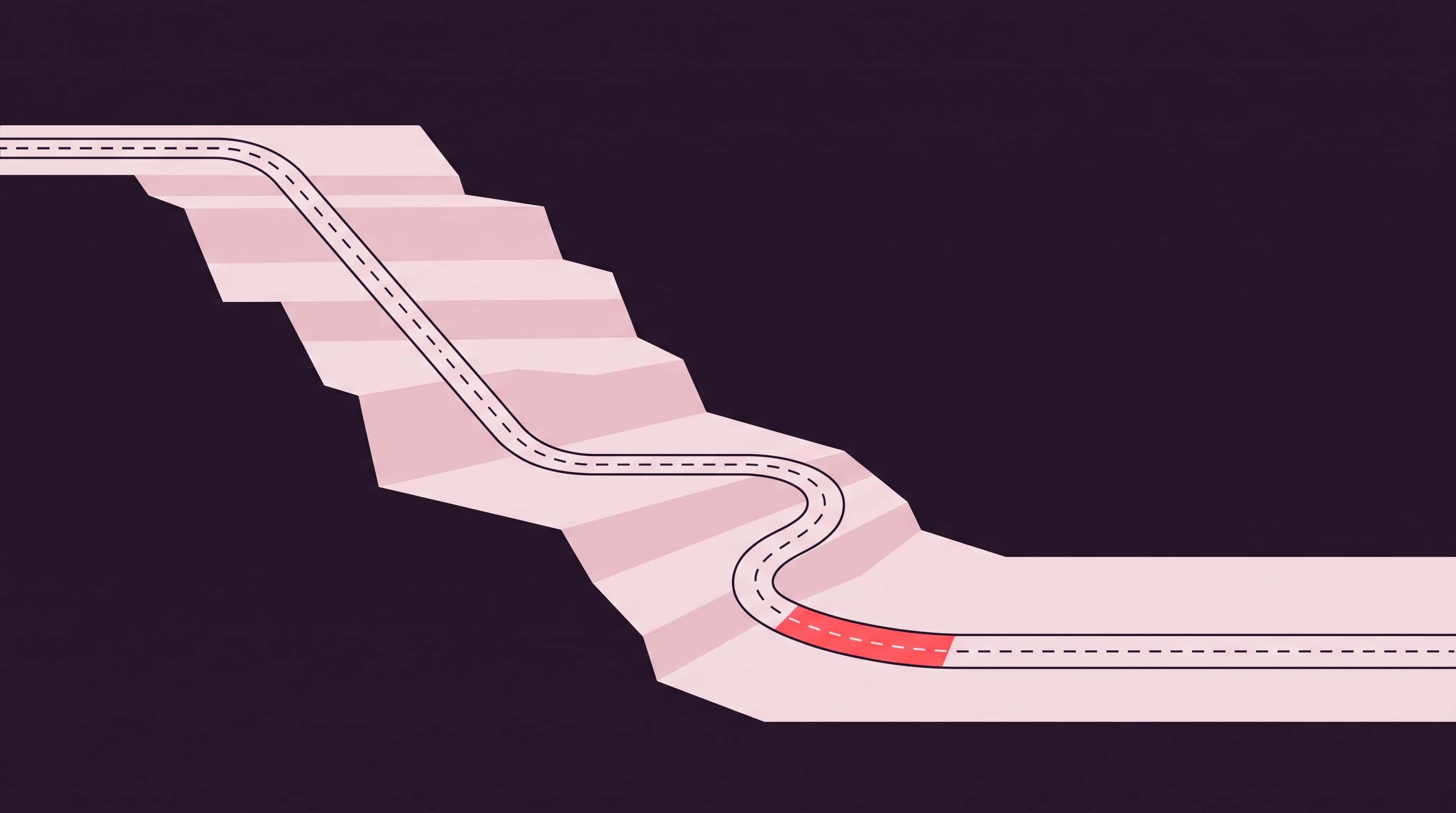
In 2025 Hyrum Oaks went door to door in Wallsburg, Utah, looking for a landowner who would host a bus turnaround. Oaks runs operations for the Utah Valley Marathon. The new turnaround let the race reroute its opening miles and cut its net drop from 1,614 feet to 1,444. That put the course just under 1,500 feet, the point where the B.A.A. now adds time to a Boston qualifier. Downhill marathons do still count for Boston. Since entry for the 2027 race, though, a big net drop costs five or ten minutes, and the biggest drops don't count at all.
How the B.A.A. measures a downhill course
The B.A.A. defines net downhill as the difference in elevation between the start and the finish. Nothing in between counts. A course can climb and fall all morning and still sit under the line if its finish is less than 1,500 feet below its start.
The penalty, which the B.A.A. calls an index, comes in three bands:
- 1,500 to 2,999 feet of net drop: five minutes added to the qualifying time.
- 3,000 to 5,999 feet: ten minutes added.
- 6,000 feet or more: the time is not accepted for Boston at all.
The index is added after the time is submitted. The adjusted time then has to beat the cutoff like any other. For 2027 entry the cutoff was 5:17 under the qualifying standard. That was the margin needed on a course with no index. On a five-minute course a runner needed to finish 10:17 under standard on race day. On a ten-minute course the margin was 15:17.
The rule took effect with the 2027 qualifying window, which opened on 13 September 2025. The B.A.A. says the indexes will stay "in place for at least the next two years." A runner picking a qualifier now is choosing for Boston 2028 under the same bands.
Why the B.A.A. added a penalty
The B.A.A. announced the change on 16 June 2025. It said it had worked with data scientists on results from 2022 onward, and that qualifiers from courses with at least 1,500 feet of net drop gained a substantial advantage. Jack Fleming is the B.A.A.'s president and CEO. He told the Boston Globe: "We didn't want there to be an unfair advantage for those who were selecting a net-downhill race specifically for the purpose of running the Boston Marathon."
The Globe had counted the effect. Around 2,000 qualifiers for the 2025 race came from courses with at least 2,000 feet of net downhill. That was nearly 10 percent of the field.
Boston's own course drops more than World Athletics allows for a record, as the B.A.A. acknowledged in 2011. The index starts at a drop about eleven times that limit.
What the first year of the index did
The B.A.A. announced 2027 acceptances on 29 September 2026. It took 25,630 runners, including 1,000 by random draw, and turned away 8,019. Only 240 of the accepted qualifying times came from courses that carried an index.
Over the same cycle the downhill races themselves shrank. Brian Rock writes the Running with Rock blog. He tracked a set of downhill marathons through the first indexed cycle, including the ones that carry no index. By his count their qualifiers fell from about 3,400 to about 1,600, a drop of nearly half. Finishers across the set fell 19 percent, to 15,670.
REVEL Mt Charleston in Nevada took the largest hit. Rock counts 812 fewer qualifiers there than the year before, a fall of 88 percent. It also lost 1,211 finishers, about half its field. REVEL has cancelled the 2027 race and moved Mt Charleston to its list of retired events, next to Reno Tahoe. The page says retired races "may return in a future year." REVEL has not given a reason. Its only public line on the index came from marketing lead Austri Biddinger, who told KPCW that "the REVEL Race Series still remains one of the most competitive opportunities to qualify."
Rock also estimates that the index potentially shaved 30 to 45 seconds off the cutoff. He calls that effect "likely minimal."
The races that moved to land under 1,500 feet
Some races chose not to be in a band at all. Rock lists the courses that changed as coming in "just under the 1,500 feet where the five minute penalty applies."
Utah Valley is the clearest case. Its old course dropped 1,614 feet and would have cost five minutes. The rerouted course drops 1,444, and the organiser now describes it as descending "just barely below the 1500 feet cutoff." Assistant race director Ethan Curtis called the course "arguably the fastest Boston qualifier in the U.S." Rock found Utah Valley had more finishers and more qualifiers in the first indexed year than the year before.
The Deseret News Marathon in Utah went further. In June 2025 KPCW reported that race director Corbin Talley put his net drop at "barely over the 3,000-foot mark." That was ten-minute territory. According to KPCW, organisers would consider moving the start "slightly down the road" to save runners five minutes. The 2026 race instead started at Mountain Dell Golf Course, just below Little Dell Reservoir. The new course drops 1,490 feet and carries no index. That is ten minutes saved, with ten feet to spare. The next edition is on 24 July 2027.
The Tucson Marathon in Arizona lists a net drop of 1,493 feet, seven feet under the line. It also lists 292 feet of climbing and USATF certification. Two independent sources, FindMyMarathon and Rock, say Tucson adjusted its course for the 2025 race to avoid the penalty. The organiser's pages don't say what changed. Rock found Tucson also grew in the first indexed year.
Steamboat sits under the line without any sign of a change for the rule. It runs from about 8,128 feet to 6,728, a drop of around 1,400 feet. FindMyMarathon lists it at 1,299.
Jack & Jill in Washington lists "~1,000 ft" of net downhill and "No Boston Marathon time penalty." Older listings gave it a much bigger drop, so the course has changed at some point. No source says when or why.
Which downhill marathons still carry a penalty
St. George in Utah drops about 2,558 feet, so its times carry five minutes. Jordan Bird, its operations manager, told KPCW: "Obviously, it's tough because we're one of the original net downhill courses that was a Boston qualifier." He added: "Not everybody races to qualify."
REVEL Big Cottonwood and REVEL Big Bear both sit in the ten-minute band. FindMyMarathon lists Big Cottonwood at 5,259 feet of net drop and Big Bear at 5,072.
The 6,000-foot band is close to empty. None of the sources for this piece lists a certified road marathon in it. The Everest Marathon starts at Everest Base Camp at 5,356 metres. By 42cal's own figures it drops about 6,286 feet, just past the cut-off. It also runs on a trekking trail with no record of certification, and Boston requires a course certified by USATF, AIMS or a national governing body.
What a big drop does to the quads
Running downhill costs less energy than running on the flat. That is the speed a canyon course sells. The bill arrives in the legs.
On a descent the quadriceps contract while they lengthen to brake each stride. REVEL's own training blog describes the quads as "subjected to repeated and high levels of eccentric force." The muscles "are pulled in two different directions at the same time."
A 2020 review in Sports Medicine by Bontemps and colleagues gathered the research on this. It found that downhill running causes muscle damage that can reduce performance. Slope, duration and speed drive the damage. Runners least used to descending suffer the most. In the studies reviewed, quad strength right after a downhill run fell by roughly 14 to 55 percent. The loss "generally" lasted up to four or five days.
The best protection the review found was prior downhill running. Even "a single bout" helps. The protection fades, though. In one study it had gone nine weeks after a 30-minute downhill run. The review found no confirmed benefit from compression garments or footwear.
REVEL's training blog gives the same advice. It recommends downhill sessions "over a number of weeks, with gradually increasing intensity and distance." It warns against relying on "a couple of downhill runs a few weeks before your race."
How to check a course before entering
Start with the two elevations. The organiser's course page usually gives the start, the finish or the net drop. Subtract the finish from the start and compare the result with 1,500 and 3,000 feet. Total descent and total climbing don't matter.
Then check the certificate. Boston rule 2.2.2 makes it the runner's job to confirm that a course has a current certification. USATF certificates are searchable on the Road Race Technical Council site at certifiedroadraces.com. Each one carries an effective date range, so the certificate has to cover race day.
Rule 2.2.5 says a time run on a course altered after certification will not be accepted. A rerouted course therefore needs a new certificate, which matters most for the races that just moved. The B.A.A. also asks races to send proof of certification and elevation to it directly. When in doubt, ask the race whether it has done so.
Finally, do the arithmetic with the index included. Take a runner who finishes 12 minutes under standard. On Utah Valley or Tucson that time counts as 12 minutes under, which cleared the 2027 cutoff. On St. George it counts as seven under and still cleared it. On Big Cottonwood it counts as two under and would have missed. The Boston qualifier calculator shows the margin for a given age and time.
Further reading
- B.A.A. qualifying page: the three index bands and the definition of net downhill.
- 2027 Boston Marathon Rules and Policies (PDF): certification rules, including the altered-course rule 2.2.5.
- B.A.A. 2027 acceptance announcement: the 5:17 cutoff and the 240 indexed times.
- Running with Rock: the final impact of the downhill index: Brian Rock's count of finishers and qualifiers through the first cycle.
- KSL on Utah Valley's new course: how the race cut 170 feet from its drop.
- KPCW on Utah race directors' reaction: Deseret News, St. George and REVEL respond to the rule.
- FindMyMarathon's downhill marathon list: net drop for most US downhill courses.
- Bontemps et al., "Downhill Running: What Are The Effects and How Can We Adapt?": the 2020 review on muscle damage and adaptation.
- USATF Road Race Technical Council: search certified courses and their effective dates.