
The email landed sometime in June. You got in, screamed, maybe cried, probably told everyone within earshot. That was Seven months ago. Now it's late February, you have eight weeks left until April 26, and the feeling in your stomach has shifted from excitement to something closer to dread.
Every single person running their first London Marathon goes through this. The training is going fine (or fine enough), but the unknowns keep piling up. Where exactly do you go on race morning? What happens when 50,000 people try to use the same toilets? Will Tower Bridge actually feel as electric as everyone says, or will you be too wrecked to notice?
In an attempt to avoid the regretful "I told you so", I did some research to understand what to expect. For the record, I'm racing my first London Marathon as well; see you at the starting (and hopefully finish) line.
Key Takeaways
- You're 8 weeks from race day. Your fitness is mostly built. The gains from here are mental, logistical, and nutritional.
- London has three separate start points (Blue, Green, Red) near Blackheath. They merge at mile 2.4. Know which one is yours before race week.
- The course has an emotional arc. Miles 12-13 (Tower Bridge) are a high. Miles 17-21 (Canary Wharf) are a grind. Knowing this in advance strips it of its power.
- You have 4-5 long runs left to lock in your fueling. Use every single one of them to practice your exact race-day nutrition.
- Arrive at the ExCeL expo on Wednesday or Thursday. Saturday is chaos.
- MarathonOS lets you build a race-day checklist and countdown so nothing gets forgotten in the pre-dawn haze of April 26.
The 8-Week Reality Check
If you're reading this in late February or early March, your big training blocks are behind you. Long runs of 16, 18, maybe 20 miles are done or nearly done. And if you feel like you should be doing more, like your training isn't enough, let me save you some grief: this is the part where more work hurts you.
Your body has banked the aerobic fitness it's going to have. The next eight weeks are about protecting it, not adding to it. Research on marathon taper protocols shows that a 2-3 week taper, reducing volume by 40-60% while keeping intensity, improves race-day performance by 2-3%. That's roughly 3-5 minutes for a 4:30 finisher.
So what do you do with these weeks? Three things. Nail your logistics. Rehearse your fueling. Learn the course.
Know the Course, Kill the Nerves
The London Marathon is not 26.2 miles of the same thing. It has moods. And knowing those moods in advance is the single best anxiety killer available to you, better than any breathing exercise or manthra.
Miles 1-3: The Chaos Merge. You start at one of three separate points near Blackheath and Greenwich Park. All three funnels merge into one course around mile 2.4. It's crowded. It's slow. Your GPS watch will be wrong because of the tall buildings and the sheer density of bodies. Let it be wrong. Do not weave through people trying to hit your target pace. There's no time to make up this early, only time to waste.
Miles 3-12: Settling In. The course rolls through Woolwich, Charlton, and down toward Greenwich. It's residential, with crowds stacked 3-4 deep in spots and thinner in others. The energy is warm but not frantic. This is where you find your rhythm. If you planned to run 10:00/mile, run 10:10 through here. Deliberately.
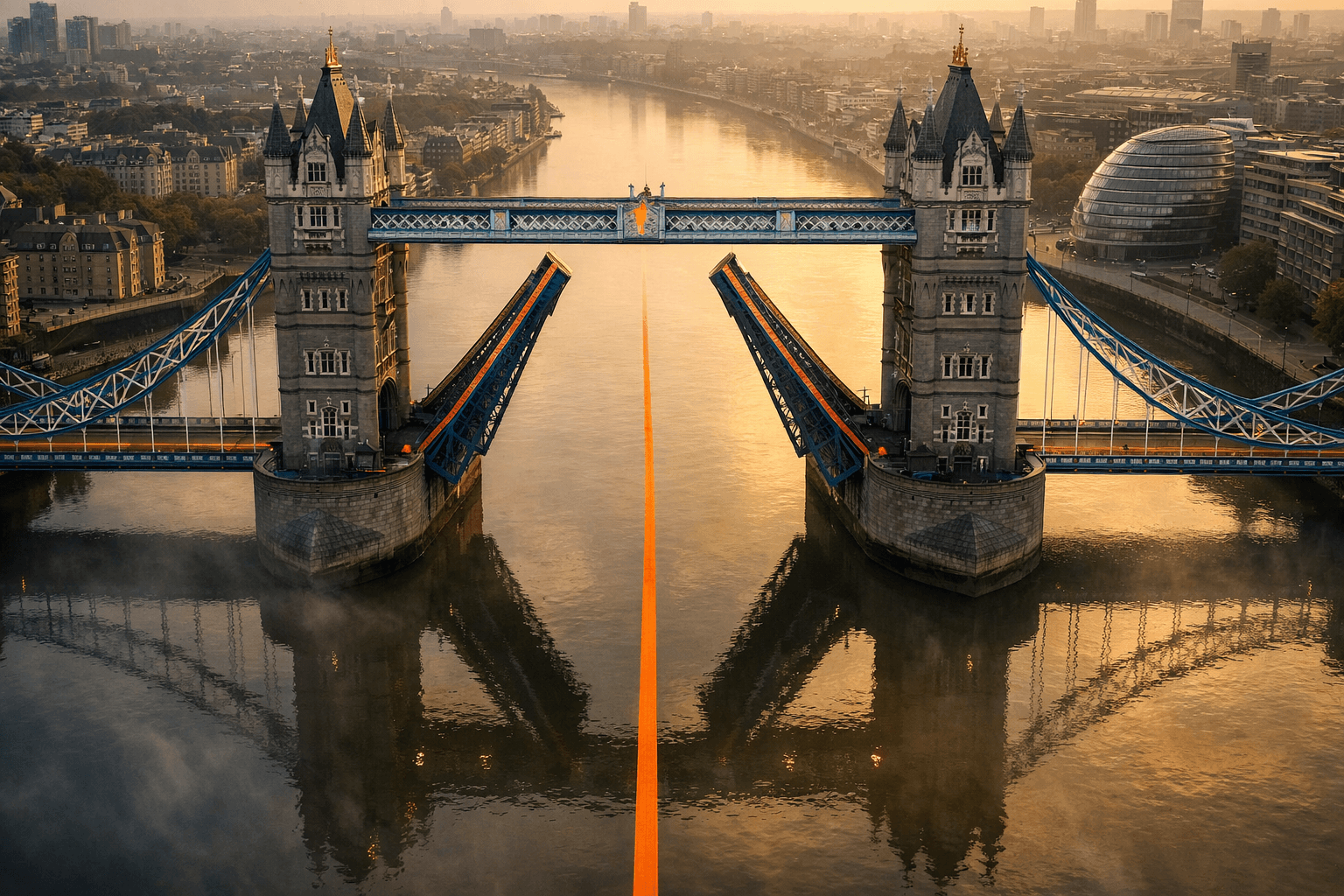
Miles 12-13: Tower Bridge. This is the moment. The roar hits you before you see the bridge. Over 750,000 spectators line the London Marathon course, and a massive chunk of them are packed right here. You'll feel invincible. Enjoy it, but watch your pace. The adrenaline spike at Tower Bridge has ruined more first-timer races than any hill ever could. If your watch shows you running 30 seconds per mile faster than planned, slow down. You'll thank yourself at mile 20.
Miles 14-21: The Canary Wharf Loop. Here's where London gets honest with you. The course dips south of the Thames, loops through Canary Wharf and the Docklands, and the crowd support thins out. The towers are tall. The road feels wide and exposed. If you're going to hit a rough patch, it'll likely start somewhere in here, around miles 17-19. This isn't the wall (that's a glycogen issue, and we'll talk about fueling). This is boredom plus fatigue, and it's completely expected.
Break this section into landmarks, not miles. "I'm running to the next water station." Then the next one. Don't do math about how far you have left. Just run to the next thing.
Miles 22-26.2: The Home Stretch. You rejoin the Embankment along the Thames. Big Ben appears. The crowds thicken again. The final mile down Birdcage Walk and onto The Mall in front of Buckingham Palace is downhill, loud, and emotional. Most first-timers describe this stretch as a blur. Your legs won't feel great. You won't care.
Race Week: The Stuff That Trips People Up
The Expo (Wednesday-Saturday at ExCeL London). You must collect your race number and timing chip in person. No exceptions, no race-morning pickup. The expo opens Wednesday and closes Saturday afternoon. Go on Wednesday or Thursday. By Saturday it's packed, lines are long, and you'll be on your feet for an hour when you should be resting. Bring photo ID.
Baggage Trucks. London uses separate baggage trucks for each start area, and they close 45 minutes before your wave starts. If you miss the truck, your bag doesn't travel to the finish. Pack your post-race clothes the night before. Lay everything out. Then check it again.
Toilets. There's no gentle way to say this: the portaloo situation at the start is rough. Plan to queue for 10-15 minutes. Get in line early. Some runners report waiting 10+ minutes for toilets mid-race too, particularly around miles 10-12. If that matters to your race plan, factor it in.
Weather. London in late April averages 8-15°C (46-59°F), but the range is huge. The 2025 race was hot enough that runners were collapsing and ambulances were visible on the course. Check the forecast three days out and plan two outfits: one for cool and cloudy, one for warm and sunny. A cheap bin liner makes a decent disposable layer for the start area.
Transport. Southeastern trains run special services to Blackheath on race morning. The Jubilee line serves Greenwich and North Greenwich. Check TfL's race-day travel page (it goes live about a week before the race) and plan your route early. Do not drive.
The Fueling Window You Can't Waste
You have 4-5 long runs left before taper eats the rest. Every one of them should be a full dress rehearsal for race-day nutrition. Not a rough approximation. The exact gels, the exact timing, the exact breakfast.
The London Marathon provides Lucozade Sport and water at regular aid stations along the course. If you plan to use those, train with Lucozade on your long runs. If the taste makes your stomach turn (and for some people it does), carry your own gels and only take water at aid stations.
A general protocol for a first-timer running 4:00-5:00 hours: aim for 30-60 grams of carbs per hour starting around mile 4 or 5. That's roughly one gel every 30-40 minutes. Your stomach needs training to handle this. If you haven't practiced fueling on the run yet, start this weekend. Not next weekend. This weekend.
And eat your pre-race breakfast at the same time you'll eat it on April 26. Race start for most waves is between 10:00 and 10:45 AM, which means eating at 6:30-7:00 AM. Practice that timing on your next long run. Your gut has a clock, and surprises on race morning are never the good kind.
Reframing the Nerves
Pre-race anxiety in first-time marathon runners is practically universal. A study from the British Journal of Sports Medicine found that psychological stress peaks in the final 2-3 weeks before a first marathon and correlates with slower finishing times when left unmanaged. Acknowledging the nerves isn't weakness. Ignoring them is the mistake.
Here are two things that actually work.
First, use London's crowd. 750,000 spectators is not a normal race. The noise at Tower Bridge, the cheering through Southwark, the wall of sound on The Mall. You don't need to generate your own motivation for most of this course. The crowd will do it. Let them. High-five kids. Smile at strangers. Research shows that smiling under fatigue reduces perceived effort and improves running economy. It sounds silly until you try it at mile 22.
Second, stop thinking in miles. Think in landmarks. "I'm running to Cutty Sark." Then Tower Bridge. Then Canary Wharf. Then Big Ben. Then The Mall. Five landmarks. That's your whole race. Five things, not 26.2.
The Week-Before Checklist
The last seven days before London aren't about fitness. They're about eliminating every possible thing that could go wrong.
Pin your race number to your shirt and try it on. Run in it for 20 minutes. If anything chafes, fix it now.
Charge your watch. Set your race-day alarms (plural, at least two). Pre-load your MarathonOS race-day checklist so you're not relying on memory at 5:30 AM.
Write your name on your shirt if you want the crowd to scream it. This isn't cheesy. It works. Hearing a stranger yell your name at mile 23 hits different.
Lay out two outfits the night before: your race kit and your post-race warm clothes. Check the weather one final time. Sleep will be bad the night before. That's fine. The sleep two nights before is the one that actually matters for performance.
One Last Thing
Your first London Marathon only happens once. You'll cross Tower Bridge exactly once as a first-timer. You'll turn onto The Mall and see the finish line for the first time exactly once. No amount of training data or logistics planning changes the fact that this is, at its core, an experience. And experiences don't need to be fast to be good.
Run your race. Not the pace you told your coworkers about. Not the pace from your optimistic February long run. The pace that lets you take in London, get through Canary Wharf without blowing up, and still have something left for The Mall.
If you're looking for a place to organize your race calendar, pacing targets, and training alongside other London Marathon runners, 42cal has you covered.
See you at Greenwich.
Further Reading
- The Ultimate Guide to Running the London Marathon (The Running Channel)
- London Marathon 2026: Your Ultimate Guide to Race Day (Visit London)
- Our Insider Guide to Running the 2025 London Marathon (Believe in the Run)
- Marathon Fueling Guide: Carb Intake, Hydration, Sodium (Runner's World)
- Marathon Mindset and Mental Strategy (The Running Channel)
- London Marathon History and Statistics