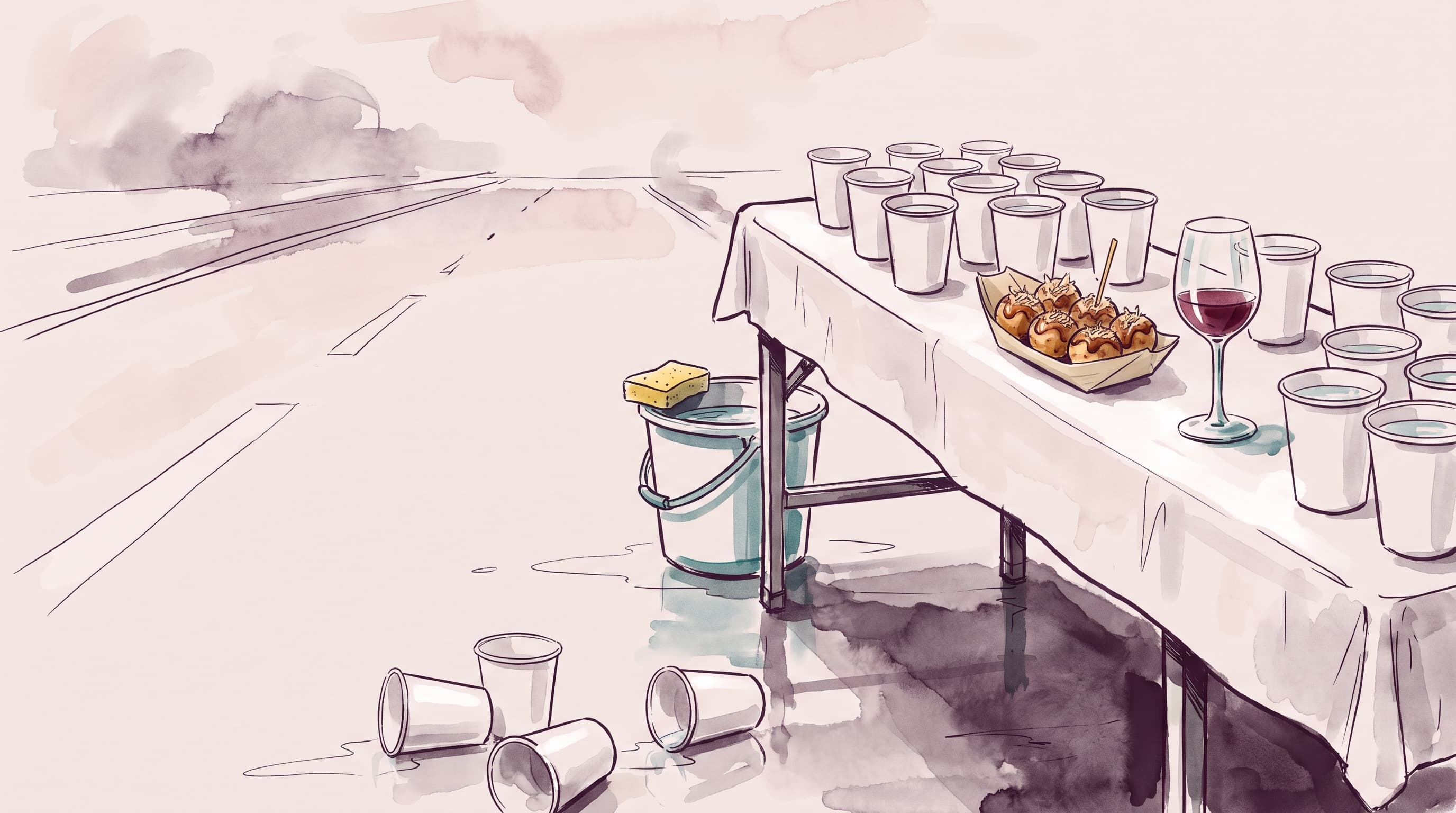
Around 32 km into the Osaka Marathon, residents from the city's shopping streets hand runners takoyaki, cream puffs and croquettes. Most marathons serve far less. At a typical aid station a runner can take water or the sponsor's sports drink. Some stations later in the race also have bananas or cola. Gels are handed out at only two or three points on the whole course.
How many aid stations does a marathon have?
World Athletics requires water roughly every 5 km, which works out to about eight aid stations over a 42.2 km marathon. Rule 55.8 of its rulebook says: "For all events, water shall be available at suitable intervals of approximately 5km." In races longer than 10 km, organisers may also offer "refreshments other than water" at the same points. The rulebook defines those as "drinks, energy supplements, foodstuffs or any other item other than water," so takoyaki qualifies.
Organisers are free to put stations closer together. A note under the rule allows water and refreshments "at more regular intervals" when the weather or the fitness of the field calls for it. The Boston Marathon has a fluid station at every mile from mile 2, about two dozen in all. The Chicago Marathon had 20 aid stations in 2026, about a mile or two apart according to NBC Chicago. Each of them also had a medical tent and portable toilets.
The Frankfurt Marathon has a full station every 5 km. In 2023 its organisers also put a water station halfway between each pair from km 12.5 onwards.
In 2019 the organisers of the London Marathon cut the drinks stations from 26 to 19 to reduce waste. The plan still promised drinks at least every two miles, starting at mile 3.
What's in the cups at most stations
Most stations have water and the sponsor's sports drink. At Boston they are Poland Spring water and Gatorade. At Chicago they are water and lemon-lime Gatorade Endurance Formula. Frankfurt's 2023 stations had Rosbacher mineral water, an isotonic drink from the same company, and tea. They also had tubs for soaking sponges.
At both Frankfurt and Chicago, the only solid food on the published menu is bananas. In Frankfurt in 2023, runners could take organic bananas from km 15 to the finish, and Bizzl Cola at km 30, 35 and 40. Chicago hands out bananas only at stations 16 to 18, near the end of the course.
In 2019 London served its Lucozade at miles 11 and 19 in compostable cups instead of bottles. At mile 23 that year, runners were handed Lucozade Sport in 25 ml capsules made from seaweed, called Ooho.
Where the gels are on the course
Gels are the scarcest thing on the course. In Chicago and New York they come from Maurten's own gel depots.
| Race | Gel points | Gel |
|---|---|---|
| Boston (2026) | miles 11.8, 17 and 21.5 | Maurten |
| New York (2026) | miles 12 and 18 | Maurten |
| Chicago (2026) | near stations 9 and 14 | Maurten |
| London (2025) | miles 14 and 19 | Lucozade Sport |
| Frankfurt (2023) | km 15 and 30 | Maurten |
At Boston the first gel station is on the Wellesley town line, the second is in Newton and the last is just after Boston College. Runners can choose Maurten's Gel 100 or the caffeinated Gel 100 CAF 100. New York and Chicago also hand out both caffeinated and non-caffeinated Maurten gels.
Runners who plan to take more than two or three gels have to start with the rest in a pocket or belt. The 42cal marathon fuel planner works out how many to bring.
Osaka's takoyaki station at 32 km
Osaka's food station is called Maido Aid. A FUN Japan report on the 2026 race, held on 22 February, says it "suddenly appears around the 32 km mark near the end of the course". According to the report, businesses from the local shopping streets organise it and local residents serve the food.
The 2026 menu had takoyaki, cream puffs, croquettes, oyatsu inari and pickled shallots. Residents also handed out small cakes shaped like Billiken, Osaka's good-luck figure. Two dishes were made with fish: tempura of hamo, a pike conger eel, and jelly made from torafugu, the tiger pufferfish. The report adds that "The menu gets better every year."
Other residents set up unofficial tables along the route. They hand out candy and chocolate, salt tablets and mikan, the small mandarin oranges.
Curry and sweets at the Kanazawa Marathon
Another Japanese race, the Kanazawa Marathon on the west coast, had five food stations at its first edition in 2015. Its organisers called them Tabemasshi stations. The first, at 14.3 km, served fruit from Ishikawa prefecture. In the old Higashi Chaya teahouse district, runners were offered two traditional sweets, kintsuba and rakugan. Later stations served rice balls made with local rice, then Kanazawa curry, then more local sweets at 36.5 km.
A 2026 guide from the running site Rundida says runners can still get Kanazawa curry, wagashi and onigiri during the race, although it does not say at which kilometres.
Oysters and steak at the Marathon du Médoc
The Marathon du Médoc, in the Bordeaux wine country, is known for the tastings along its course. A guide to the race by the French outdoor retailer Tonton Outdoor counts 23 tasting points. According to the guide, oysters are served at km 38 and entrecôte at km 39. A 2016 Tasting Table piece on the race's wine tastings also describes oysters, entrecôte, cheese and ice cream on the course.
The oysters and steak are not on the organiser's official list, though. Its 2026 runner guide names only plainer refreshments: water, cola, orange, bananas from the French Antilles, sweet and salty biscuits, sugar and energy bars.
Further reading
- World Athletics Competition and Technical Rules, Book C2.1: Rule 55.8 sets water at about every 5 km and defines refreshments.
- Boston Marathon course page: the B.A.A.'s exact gel locations and products.
- Boston Marathon 2026 course map (PDF): fluid stations every mile, with water and Gatorade.
- NBC Chicago's 2026 Chicago Marathon race-day guide: the 20 aid stations, bananas and Maurten depots.
- Maurten at the New York City Marathon: gel depots at miles 12 and 18.
- London Marathon Events on using energy gels: Lucozade Sport Gels at miles 14 and 19.
- Coach on London's 2019 sustainability changes: fewer stations, compostable cups and seaweed capsules.
- Frankfurt Marathon refreshment plan: the race's 2023 station-by-station menu.
- FUN Japan on the Osaka Marathon's Maido Aid: the 2026 food station and its menu.
- The first Kanazawa Marathon's food stations (Japanese): the five Tabemasshi stations in 2015.
- Rundida on marathons known for food (Japanese): Kanazawa's stations as of 2026.
- Tonton Outdoor on the Marathon du Médoc (French): tasting stops, oysters and entrecôte.
- Marathon du Médoc 2026 runner guide (PDF, French): the official refreshment list.
- Tasting Table on the Médoc's wine tastings: a 2016 account of the food on the course.