
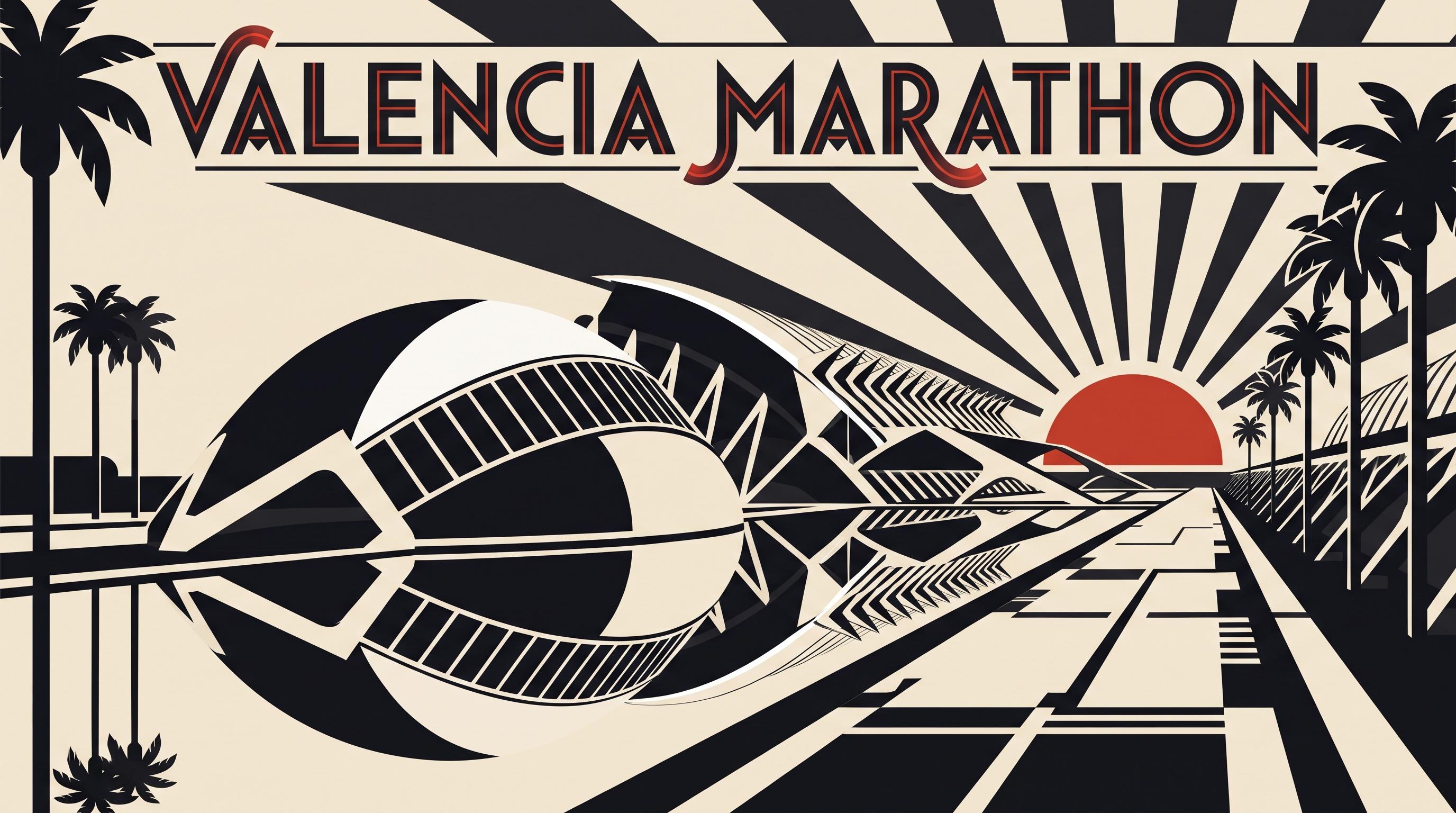
Runners finish the Valencia Marathon on a blue carpet laid over the water at the City of Arts and Sciences. Before that they run 42 flat kilometres out towards the sea, along the old bed of the Turia river and through the narrow streets of the old town. The 2026 race is on Sunday 6 December.
Getting to Valencia
Metro lines 3 and 5 take about 20 minutes from the airport to the city centre. At weekends the trains run every 15 to 20 minutes from 5:00 until half past midnight.
The high-speed train from Madrid takes about two hours and arrives at Joaquín Sorolla station. Runners can get at least 15% off Renfe's long-distance trains to Valencia, thanks to a deal with the organiser. The discount covers travel from 1 to 13 December. To book it, runners choose Renfe's "NEC Congress/Fairs" fare and enter an authorisation number from the organiser.
Where to stay
The race begins and finishes at the City of Arts and Sciences. Booking a hotel in this district can mean a short trip to the start and an easy walk back afterwards. The area is also on tram line 10.
Staying in the old town puts Mercado Central and Horchatería Santa Catalina within easy reach. So are four of the rice restaurants listed below. The course runs through these streets between km 29 and 31, so a few days there offer a chance to walk that stretch before racing it.
For anyone who wants to eat well, Ruzafa and the Ensanche are the places to stay. Canalla Bistro by Ricard Camarena is in Ruzafa, and three of the Michelin-starred restaurants listed further down are in these two districts.
By the beach, Cabanyal and Malvarrosa make a pleasant base for the days around the race. Tram lines 4 and 6 run to Malvarrosa, although on race morning in 2025 both were cut or partly closed until late morning.
For hotels more than 2 km from the start, bookings through the organiser's hotel partner WelcomeToValencia include a race-day transfer for runners and their companions.
There is no need to stay near the expo at Feria Valencia, since runners only go there once.
Picking up the bib at Expo 42K
Bibs can only be collected at Expo 42K, which runs over three days at Feria Valencia.
| Day | Expo hours |
|---|---|
| Thursday 3 December | 17:00-21:00 |
| Friday 4 December | 9:00-21:00 |
| Saturday 5 December | 9:00-19:00 |
| Sunday 6 December | No pickup |
Metro lines 2 and 4 and bus 62 all stop there.
Runners whose flights land after the expo closes can send someone in their place, as long as they authorise that person beforehand in the Runner's Area of the organiser's website.
The bag drop is no longer free
Older guides describe a free cloakroom at the start. This year the bag drop is a paid extra that had to be booked in advance, and it can no longer be added to an entry. Without it, the simplest plan is to bring nothing that needs to come home, or to hand a bag to whoever has come to watch.
Transfers, refunds and the age rule
Entries can only change hands through the Runner's Area, and an unauthorised transfer can mean a four-year ban from the race. Runners who added the Reembolso refund service can claim back 80% of their entry until 29 November. Everyone must be 18 on race day, and children cannot take part even in a buggy. Other big marathons handle missed races differently, and this comparison of deferral rules shows what each one allows.
Saturday: a breakfast run and a paella party
On Saturday, the Bimbo Breakfast Run is an easy 5K training run through the Jardí del Túria. Children have their own race that day, the MSC Mini Marathon.
Valencia skips the pasta party in favour of paella. The Paella Party La Fallera takes place the day before the marathon and, according to the organiser, brings together thousands of runners and their companions.
Getting to the start on Sunday morning
The start line is on Plaça de la Marató, with the bag drop on the avenue beside it. Getting there takes some planning, as roads close and buses and trams are rerouted around the course.
Last year the city bus company EMT changed dozens of lines from Friday until the race was over. Lines 35, 99 and C3 were named in advance as the buses to take to the start, and tram line 10 ran only in part until 10:00.
This year's plan will appear in the organiser's race-day transport guide. The race-services page still marks it "Coming soon", so it is worth checking again in the final week. It is the kind of reminder worth putting in MarathonOS, an app that keeps race-week checklists on the phone with a countdown on the Lock Screen.
Nine waves from 8:15
Runners start in nine waves according to their accredited time. The first wave leaves at 8:15 and the rest follow every ten minutes until 9:35.
| Accredited time | Wave start |
|---|---|
| Under 2:50:00 | 8:15 |
| 2:50:00-2:59:59 | 8:25 |
| 3:00:00-3:11:59 | 8:35 |
| 3:12:00-3:19:59 | 8:45 |
| 3:20:00-3:31:59 | 8:55 |
| 3:32:00-3:42:59 | 9:05 |
| 3:43:00-3:55:59 | 9:15 |
| 3:56:00-4:09:59 | 9:25 |
| Over 4:10:00 | 9:35 |
Wheelchair athletes start early in the 8:35 wave. Visually impaired athletes may start at the front of their own wave.
One cut-off at km 25
The time limit is five and a half hours and the course closes by 15:15. Runners who reach km 25 after 12:57 must hand in their bib and stop. It is the only cut-off on the course.
Because the cut-off is a time of day, it is tightest for the last wave. A 9:35 start leaves 3 hours 22 minutes to reach km 25, which is a little over 8 minutes per kilometre.
The course, from the bridge to the water
The organiser calls the route "the world's fastest and flattest circuit". It runs at sea level and its rises are gentle, never more than 1%. From the start it heads out towards the sea and round the city's northern boulevard, then comes back through El Cabanyal. Later it follows the old Turia riverbed into the historic centre and returns to the water for the finish.
Marathon Handbook recommends even splits through at least 30 km. On a course this flat that is a realistic plan, and the pace calculator gives the even split for any goal time.
Start to km 2.5: the bridge and the bike lane
The field crosses the Montolivet bridge and goes round Plaza de Europa onto Padre Tomás Montañana. The road is crowded here and runners weaving through the pack need to watch for the separators along the bike lane.
Km 2.5 to 8.7: wind by the sea
From km 2.5 the course goes out and back along Avenida de los Naranjos. The wind can be strong on Eugenia Viñes, the street nearest the sea. Marathon Handbook's advice is to ease off into the wind rather than fight it so early. Around Avenida de Cataluña the course makes a double 90-degree turn, where a 2025 course guide on Blogmaldito warns runners to "watch out for the streetcar rails".
Km 8.7 to 15.3: Periférico Norte
The Blogmaldito guide calls Boulevard Periférico Norte the blandest part of the course. Wind is possible here too and there are more tram rails to cross at Doctor Vicente Zaragozá.
Km 15.3 to 24: the lull and Avenida del Port
Marathon Handbook warns of a mental lull between km 15 and 20. After km 20 the course comes back through Cabanyal onto the long straight of Avenida del Port, which rises slightly near its end.
Km 24 to 31: the Turia and the old town
From km 24.5 the course runs along the old Turia riverbed past big crowds. It is flat or rises slightly until about km 27.5.
Between km 29 and 31 the route passes through Ciutat Vella on streets that twist and are narrower than anywhere else on the course. Large pace groups get cramped here. The Blogmaldito guide advises against letting the crowds push the pace.
Km 31 to 38.5: Vall de la Ballestera and the Bioparc
From km 31 to 34 the course climbs Vall de la Ballestera at no more than 1%. The slope can be windy and it comes as legs begin to tire. Marathon Handbook suggests holding back here and using km 34 to 37 to recover.
Somewhere between km 34 and 38.5 comes a straight of about 2 km near the Bioparc. It is long and has fewer spectators than the rest of the course, which makes it mentally hard. With about 9 km still to go, the Blogmaldito guide's advice is not to push.
Km 38.5 to the finish
The crowds build again along Passeig de la Ciutadella. From there the course returns to the City of Arts and Sciences and finishes in front of the Hemisfèric.
Water, gels and pacers
Drinks stations come about every 5 km up to km 30 and more often after that. The finish has food as well as drinks. Water comes in bottles and Aquarius in cups.
Enervit runs three gel points called Red Points with gels both with and without caffeine. In 2025 the Blogmaldito guide found gels at only two places, km 16.2 and km 25.8. The safe plan is to carry every gel the race needs, and the marathon fuel planner works out how many.
Farmacia Ribera has assistance points with vaseline and analgesic spray at km 24.5, 29.5 and 34.2. Medical services are along the route and at the start and finish.
The official pacers are called Prácticos MSC. They carry a visible banner and run an even pace, but their goal times have not been published.
December weather: cold at the start, warm by noon
Early December in Valencia is usually mild. Spain's weather agency AEMET records average lows of about 8 °C and highs of about 17 °C for the month at its Valencia station. Rain of 1 mm or more falls on just under five days in an average December, so a wet race is possible but uncommon.
NASA's POWER model estimates the temperature around the start at about 3 °C in 2023, 11 °C in 2024 and 9 °C in 2025, so race mornings vary more than the monthly average suggests.
By noon in 2024 and 2025 it had climbed to about 19 °C. Runners in the later waves spend more of their race in that warmth, and every degree of heat costs time. A cheap layer to throw away in the corral is worth bringing in most years. A report on Carreras de Montaña described the 2025 race as having "temperatura fresca, ausencia de viento significativo" (cool, with no significant wind).
Eating on Spanish time
Restaurants in Spain usually serve lunch from 13:00 to 16:00 and dinner from 20:00 to 22:30. Most shops and businesses close on Sundays.
Dinner at 20:00 is late the night before an 8:15 start. One way around it is to book a table for the moment the kitchen opens. Another is to make Saturday lunch the main meal, which suits Valencia well because paella is a lunch dish.
Where to book a paella
Visit Valencia recommends these restaurants for rice:
- Historic centre: Pelayo Gastro Trinquet, Vaqueta Gastro Mercat, Puerta del Mar and Juliana.
- Around the start and finish: Rocalla, Enbogabar and Restaurante Poble Nou.
- Beaches and sea towns: Casa Isabel, La Alegría de La Huerta and La Colonia de Carmela.
- The Albufera, the lagoon outside the city where paella comes from: Casa Quiquet, Restaurante El Palmar and others.
Near the finish it also suggests Contrapunto Les Arts for Mediterranean food and Bar Cremaet for tapas. In Cabanyal its tapas pick is Bodega Casa Montaña.
For a celebration dinner, Flores Raras in the historic centre has two Michelin stars. Lienzo, also in the historic centre, has one, as do La Salita, Riff and Fierro in Ruzafa and the Ensanche.
Horchata and fartons
Horchata is a cold drink made from "tiger nuts, water, and sugar". It comes from Alboraya, a town just north of Valencia. Its tourism office says that "horchata is to Alboraya what paella is to Valencia". It is served with fartons, and both horchaterías below have them.
Horchatería Santa Catalina is in the old town. Time Out calls it "este pequeño museo de la horchata, el chocolate, los fartons y los buñuelos" (this little museum of horchata, chocolate, fartons and fritters). It is open every day from 8:15 to 21:30, including race Sunday.
In Alboraya itself Horchatería Daniel has made horchata and fartons since 1949. It is open on Sundays from 10:00 to 22:30 and also has a counter in the city at Mercado de Colón.
Mercado Central is the city's main market. It opens Monday to Saturday from 7:30 to 15:00, so the time to go is Saturday morning or the Monday after the race.
After the finish
Past the finish line, runners can have their medal engraved and get help from Farmacia Ribera. Showers are available at the San Luis municipal swimming pool from 10:00 to 17:00.
A Monday lunch at Casa Carmela
Casa Carmela on the Malvarrosa seafront is closed on Sundays, which makes the Monday after the race the day for a long lunch there. It was founded in 1922 and wood-fired paella is its speciality. It serves lunch only, from 13:00 to 16:00. The kitchen makes a limited number of paella valenciana each day, so it is best to order the dish before the trip.
Further reading
- Valencia Marathon 2026 regulations: start time, waves, cut-off, fees and aid stations.
- Reglamento Maratón Valencia 2026 (Spanish): the correct expo dates, transfers and refunds.
- Official route: the course, refreshment points and the finish over the water.
- Race services: bag drop, pacers, showers and the race-day transport guide when it appears.
- Parallel events: the Breakfast Run, Mini Marathon and Paella Party.
- Organise your trip: the official hotel partner and its start-line transfers.
- Renfe discount: how to book the runners' train fare.
- Blogmaldito course guide: a Barcelona runner's 2025 kilometre-by-kilometre analysis, with route notes from the Valencian pacer Julio Belmin.
- Marathon Handbook 2025 race guide: pacing advice for each part of the course.
- 2025 race-day closures (elperiodic): last year's bus, tram and road changes.
- Metro in Valencia (Visit Valencia): airport lines, hours and tram routes.
- AEMET climate normals for Valencia: December averages from 1981 to 2010.
- Carreras de Montaña 2025 race report: results and conditions from the 2025 edition.
- Where to eat in Valencia (Visit Valencia): rice restaurants and tapas bars by neighbourhood.
- Casa Carmela: hours and paella bookings on the Malvarrosa seafront.